Showing posts with label parasites. Show all posts

Wednesday, April 11, 2012

The Mantidflies, family Mantispidea

For those who are afraid of insects, the above image will probably haunt your dreams for years to come.  For the rest who are unfamiliar with this unusual insect, your first reaction may be to stare in disbelief at what, for the sake of your sanity, you hope must be photoshopped.  But it is a very real insect.  Appearing to be what happens when you graft the front end of a Praying Mantid on to the body of a wasp, this bizarre amalgamate of a creature is actually not closely related to either.

The Mantidflies or Mantsipids, family Mantispidae, are a group of insects who are most closely related to the Lacewings and Antlions.  Belonging to order Neuroptera (the net-winged insects), these predatory insects are, despite their potentially disturbing appearance, harmless to humans.  With over 400 species currently recognized and with ranges throughout much of the world, they are a surprisingly common, if poorly known group of insects. 

Nearly all Mantidflies have an appearance closer to a fusion between Lacewings and Mantids, but a couple species have developed a form of mimicry to avoid their own predators.  These, like the above Climaciella brunnea, have an appearance that is close enough to those of wasps to deter most predators.  Their Batesian Mimicry --the process of a harmless species having the appearance of a dangerous one-- has gone so far as to take on the form of whatever the most populous species of paper wasp from the genus Polistes is in their area.  Because of this, their appearance will vary from region to region despite all being members of the same species.

The Green Mantidfly, Zeugomantispa minuta

The larvae of Mantidflies are, like their adult form, strict carnivores.  In some species, the larvae will actively hunt the larvae of other insects, such as beetles and flies, where as others are known to be parasitoids of wasps, bees, and even spiders.  It is the case of the spider parasitoids there is a disturbingly high degree of specialization to be found.

Those species that target spiders can be divided into those with two distinct strategies.  The egg penetrators and the spider boarders.  The egg penetrators, like the above Green Mantidfly, have active larvae that seek out spider egg cases and, upon finding one, chew through the top and climb inside.  They then begin to feed on the developing spiders as they go through their various stages of metamorphosis safe within the spider's egg sac.  Eventually, an adult emerges from the empty cocoon and flies off.

The spider boarders, however, have lost the ability to chew into a spider's egg case and instead waits for a spider to walk by.  While this may seem close to suicidal, the tiny larvae can often climb on to a spider and latch on without difficulty.  The small, flattened larvae attaches itself to the underside of the abdomen where it can patiently wait.  It nourishes itself by feeding on the hemolymph, the blood, of the spider.  If the larvae has found itself on an immature spider, some species are known to simply crawl into the book lungs of the spider where it will be safe from being dislodged when the spider molts.

If the larvae is lucky, it will have found a female, but it will make do with a male as well.  Here, it will simply wait for the male to find a female to mate with and jump ship as the two mate.  Once on the female, it waits for its host to lay its eggs.  As the spider is spinning the silken cocoon around the eggs, the Mantidfly larvae crawls inside undetected.  It then enters its next stage, a grub-like form that has only one goal, feed.  Once it has consumed the contents of the egg cocoon, it will spin its own cocoon and metamorphosize into its adult form.

Such spider parasitoid Mantidflies are far from rare.  They are so common that all major groups of hunting spiders are attacked by these spider boarding larvae.  While web building spiders are safe from this fate, many still end up being the targets of the egg penetrating species.

Such spider boarders are so common that a fossil of one has actually been recently found.  Discovered by Michael Ohl of Berlin's Museum of Natural History, the larvae was found attached to a spider that had been unlucky enough to find itself not only with the parasitoid Mantidfly larvae but also caught in tree sap.  As the sap hardened over time, the two were preserved perfectly in amber.  Dating to around 44 million years ago, the specimen shows that this form of symbiosis has been used in what is essentially its present form for quite some time.  It is possible that this tactic goes back even farther as the earliest Mantidfly fossils date to the early Jurassic, 180 million years ago.

A spider in amber with a Mantidfly larvae still clinging to its host.

Images courtesy of WeedsWorth.com, BugGuide.net and Discover Magazine.
Facebook Digg Stumble Delicious Twitter Reddit Technorati

Friday, March 2, 2012

The Green-Banded Broodsac - Leucochloridium paradoxum


The Green-Banded Broodsac is name that is equally horrifying and mysterious.  The fact that they were given the descriptive title of 'green-banded' suggests that we live in a world so full of organisms befitting the name of a broodsac to need clarifiers.  This alone should be enough to haunt your dreams for weeks to come. But it does leave one with the simple question of what it could possibly be, other then horrifying.

The Green-Banded Broodsac (Leucochloridium pardoxum) is a trematode, a class of flatworms (phylum Platyhelminthes) known for their exclusively parasitic nature.  Trematodes, more commonly known as flukes--and in the case of the Broodsac, a Digenean--go through a series of developmental stages that take them through multiple host species.  In  L. pardoxum, the lucky contenders are the Amber Snails (genus Succinea) and various species of shore birds.

The Broodsac's primary hosts are the shore birds. Here they live in the digestive tract like many other Trematodes, feeding off of allthe extra nutrients. Other than depriving their host of some nutrients, they don’t really hurt the birds, which is good for the Broodsac as if the bird dies, so do they. 

The adults live out their lives passing their eggs out through the digestive tract of the infected birds. They are monecious, meaning they possess both sexes and can either self-fertilize or cross fertilize when multiple individuals are close enough together, so there is always a 'healthy' supply of eggs.

The eggs lie in wait for a hungry snail to come along to feed on the bird droppings that they reside in.  Once consumed, the eggs hatch into the initial larval stage, the miricidia. These miricidia start out by thriving in the gut but soon begin to spread through the body of the snail as their numbers grow, with the luckiest finding themselves near the head.  It is here that they metamorphose into their next stage, the sporocyst.

While the miricidia are capable of movement, the sporocyst is not.  At first they begin to rapidly reproduce themselves until they have developed into a large ‘brood sacs’.  It is from this stage that they get their shiver inducing name.  As the brood sac grows in size, it begins to invade the eye stalks of the snail, preferring the left one for some utterly unknown and possibly terrifying reason, though it is not uncommon to see snails with both eye stalks infested.

The sporocysts within the brood sac can either divide into more sporocysts or they can produce for yet another stage, known as the cercaria.  The brood sac quickly becomes filled with hundreds of cercariae which are the final larval stage of these horrors, and the first stage that can actively infect their primary hosts.  Many of the cercaria will encyst themselves, becoming metacercaria, to preserve themselves for when they enter a more suitable habitat, namely the gut of a bird.

But how can such tiny creatures hope to go from their comfy, bloated sack of a home inside the head of a snail to the promised land that is the intestines of a bird?  Once again the titular broodsac comes into play.  There is a reason why the broodsac forms specifically in the eye stalk and head.  As it grows in size, it begins to gain a very specific coloring, hence the green-banded portion of L. paradoxum's common name.  The bands of green and yellow very closely resemble the markings on certain species of caterpillars.  Particularly, species of caterpillars that are commonly fed upon by birds.

But the broodsac doesn't stop there.  It has already reduced the vision of the snail enough to hinder its ability to hide but evolution was not content with merely impairing the depth perception of the hapless snail.  Instead it begins to alter the behavior of the snail.  Snails naturally prefer the dark; this is because there is more rotting detritus for them to feast upon and fewer predators to eat them. But L. paradoxum wants desperately to get back into its primary host. So it over rides the snails preference for the dark and causes it to seek out the light where it will be more noticeable to birds.

Once in the light, the brood sac begins to twitch.  The more light it is exposed to, the more rapidly it will convulse in a way that, to a bird, resembles a snack that cannot be turned down.  This behavior, known as aggressive mimicry, is usually reserved for predators so that they can sneak up on their prey, but here, the broodsac has used the technique to attract its future primary host.

Once the snail is eaten--or just the infected eye-stalk which can potentially grow back and become re-infected by the miracidiae still thriving inside the snails gut--the cecariae collect inside the intestines and develop into the adult form.  Any metacecariae will come out of their stasis as the surrounding tissue they have encysted themselves within is digested away and the remaining sporocytes will develop into cecariae as well, which in turn also develop into the adult form; thus creating a large and stable population.  

The adult worms, then go about their happy lives doing little more than reproducing and feeding off the various nutrients they are constantly bathed in.  Spewing out a steady stream of eggs that, with any luck, will go on to infect and deform other helpless slime crawlers.


Facebook Digg Stumble Delicious Twitter Reddit Technorati

Friday, May 13, 2011

Pseudacteon

What child was not given an ant farm at one point in their lives (or if you were poor, just played with the ants that undoubtedly crawled throughout your kitchen stealing what little food you had)? Spending hours watching them make their endless tunnels only to eventually grow bored and end up shaking the whole thing to destroy their painstaking work to prove that you were the superior species.

The ant farm: bringing out the sadist in children since 1956.

But when nature looks down on the tiny any, she doesn’t see hours of discovery and wonderment. No, she sees a seemingly endless supply of potential zombies. In fact nature loves infecting the insect world’s tireless little laborers, proving that even the universe looks down upon dutiful workers as nothing more than a disposable resource. From the Ophiocordyceps unilateralis, a fungi that forces its host to climb up a plant stalk above the colony and grab onto the plant with its mandibles until it dies and a stalk grows from its head to rain down its zombifying spores upon the hapless colony; to Dicrocoelium dendriticum, a lancet fluke that also causes ants to climb up plant stalks (but only at night while the rest of the colony is sleeping so as not to be noticed, like some sort of horrible were-ant) so that it may be eaten by grazing sheep and cows, its primary hosts. But the absolute most terrifying has to be Pseudacteon, a genus related to the harmless but ever annoying fruit fly. As we all know, evolution is not content to keep anything harmless when there is a way to turn it into a source of our deepest fears. The female of these tiny flies (about the size of an ant’s head) search for colonies of only one species of ant (the species depends on the species of Pseudacteon). When it finds a suitable host, it dive bombs the ants until it can grab one and stab its thorax with its ovipositor, injecting it with a single egg before flying off. At this point the ant is probably freaking the hell out, but other than having a crazy story to tell the rest of the colony that must be reminiscent of hillbillies and their stories of alien abduction, the ant is mostly unharmed.

As the ant is being told that it was just a crazy dream by its nest mates, the egg hatches and migrates to the head of the ant. It is here that it begins to feast on everything around it. As more and more of its brain is eaten away, the ant begins to wander away from the colony in a rather aimless fashion. A few days in, the entire contents of the head are eaten yet the body continues to wander at behest of its new master. At this point the ant is a zombie in the traditional sense, a dead body wandering about, and yes, only a head shot can ‘kill’ it.

Years of survival horror games have prepared you for this very moment.

Eventually the larvae is ready to pupate, but having the zombie body would just be a hassle, so it does what any self respecting source of terror does, it causes the head to fall off and uses the empty skull as a cozy metamorphosis chamber. It then emerges a fully developed fly and buzzes off to find a mate and continue the cycle anew. I’m sure this is exactly what Disney had in mind with that “Circle of Life” song from “The Lion King”.

To make sure you don’t sleep ever, I should let you in on a little secret. These tiny abominations that would give Ridley Scott nightmares are being bred in captivity en mass. You see, a particular species preys only on Fire Ants, a species of ant that has been invading vast areas of land throughout the Americas. To combat this, certain groups in the Unites States have decided it would be a good idea to raise huge amounts of these face-hugger flies and see if they might help control the spread of Fire Ants. Thus far, the project has shown no noticeable change in the spread of these invasive ants. But when the tiny zombie apocalypse occurs, we will at least know who to blame, we’re looking at you University of Texas at Austin. Why are we not surprised that Texas would be the one to doom us all.
Facebook Digg Stumble Delicious Twitter Reddit Technorati

Tuesday, April 5, 2011

Toxoplasma gondii

Toxoplasma gondii is a parasitic protozoan whose primary hosts are cats; however they can infect most warm-blooded organisms, though generally are not able to propagate in many of these hosts. In their hosts they encyst within both muscle and brain tissue. Because they live within the cells themselves the immune system generally will not notice them. They then pass their oocytes (egg cells) out through the feces of the cat. It is here where it can infect its next host. Its prime intermediate hosts are rodents such as rats and mice. In these, they display the best known form of mind control.

Naturally rats are afraid of the smell of cats, especially certain chemicals in their urine. But once Toxoplasma takes hold, infected rats actually will go seeking out this scent and hang around the location as if they are waiting for the cat to show up. And once a cat does, instead of following its instinct to run like hell they have been known to even walk right up to them. The cat, being slightly confused, decides not to look a gift rat in the mouth and eats the brain washed rodent.

This adorable image brought to you by a mind controlling parasite.

But evolution wasn’t satisfied with just fucking with the brains of tiny rodents. Remember that thing a bit ago about Toxoplasma being able to infect most warm blooded animals? Well for those of you who didn’t flunk biology, you might be saying to yourself “Wait, I’m a warm blooded animal”. Not only would you be right, but there is a pretty good chance you have a very personal relationship with this tiny monstrosity. The numbers are a bit sketchy but some studies hold that about 50% of humans are infected with Toxoplasma. The less paranoid of you may have come to the seemingly rational conclusion that while this is a terrifying number, they are, with few exceptions, not a rat and therefore safe. Well I hate to be the one to tell you but studies have shown that Toxoplasma may very well be affecting you too. Studies have shown that this parasite has been linked with distrustfulness and greater risk taking behavior in males as well as causing females to be more outgoing and warmhearted. It has even been suggested that if the parasite is passed on to the fetus it may increase the probability of schizophrenia in the child. So the next time you are caught talking to the voices, just tell the people in the white coats that a tiny parasite living in your brain made you do it, I’m sure they will understand and let you go.

Insanity:  tiny kernels of green corn living in your brain.
Facebook Digg Stumble Delicious Twitter Reddit Technorati

Tuesday, March 22, 2011

Sacculina carcini

Succulina carcini starts life as a harmless little critter who lives a care-free life exploring the busy world of the planktonic drifts. Its larvae look like something H. R. Geiger would have created if he went through a cute phase.

Who’s an adorable little Cthulian horror?

But just like any spawn of an Elder-God, there comes a time when they just want to settle down. So the females search for the perfect home to eventually raise their own brood of Lovecraftian abominations. But not any home will do, no, the females are very picky about where they make settle. In this case it is an unsuspecting crab.

Hello mister crab! Doesn’t he look happy?

It is now that Succulina swims underneath our happy little crab there and using a needle on the rear of its body injects a cluster of cells into the crab and simply discards with the remaining 90% of its body. As if this were not disturbing enough, the protoplasmic blob that is left over begins growing tendrils throughout the body, including the brain and around the eye stalks. It uses these nightmarish appendages to leach nutrients from our once happy crab. Eventually a cancerous blob begins to grow on the underside of our once care-free crab. Known as the externa, this is the egg sack of our once terrifying yet oddly cute free-swimming friend.

Holy Hell! What did you do to Mister Crab?!

But the cancerous abomination and internal leech tentacles are not the worst part. Yes, it really can get worse. Remember when I said they grow all the way to the brain? Well there is a very specific reason for this. This is because it needs to take over the mind of its unwitting host. It stops the crab from molting (as this would cause it to shed the externa) and just grow and grow. It changes its habits so all it does is eat and carefully groom the cancer pouring out of its carapace like it is its own egg sack. It doesn’t even matter if it was a female crab that was infected either. Sacculina will just change the hormone levels of a male crab so that its underside grows wider like a female (all the better for the externa to grow). It also effectively sterilizes the crab so that it never has any interest in any other crab. It just eats and grooms the progeny of The Blob. When the eggs are finally ready to hatch, Sacculina takes further control of the crab, forcing it to walk into shallow water and shake open the externa so that all the little larvae may swim free in a horrifying imitation of the crab’s own ritual of releasing its eggs. This completes Sacculina’s life cycle with thousands of tiny larvae off to find crabs of their own to infect. And just to make matters just a tiny bit worse, Sacculina is actually just a specialized form of barnacle. Try looking at those ubiquitous shore side critters again.

------------------------------
References:
Zimmer, Carl. Parasite Rex
Facebook Digg Stumble Delicious Twitter Reddit Technorati

Saturday, February 5, 2011

Glyptapanteles, a parasitoid wasp

Glyptapanteles is a genus of wasp that makes my argument as an atheist just a little bit easier. The reason I say this is because there is no way a benevolent deity could create something like this. Glyptapanteles is what is known as a parasitoid wasp. A parasitoid wasp is any wasp that employs parasitic behavior at one point in its life cycle. There are quite a few examples of these in nature, but Glyptapanteles has to be the most disturbing.

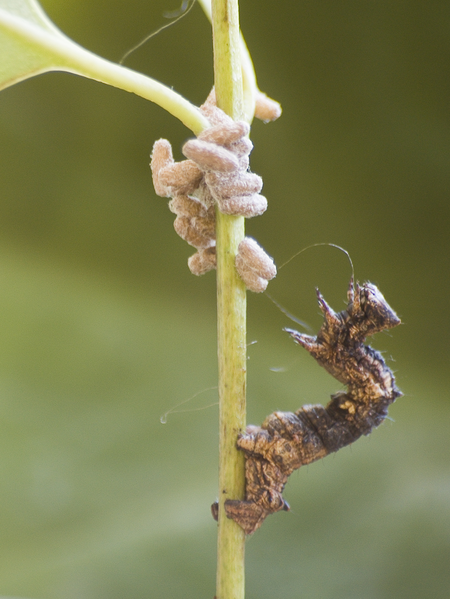
When a fertile Glyptapanteles wasp is about to lay her eggs, she seeks out a caterpillar. While it is unknown if the wasp can parasitize any species, it is know to seek out at least three specific species: Lymantria dispar, the Gypsy Moth; Chrysodeixis chalcites, the Golden Twin Spot Tomato Looper; and Thyrinteina leucocerae, the Geometrid Moth. Upon finding one of these caterpillars, she stings it, injecting a paralyzing venom to keep her subject still. This is key as the wasp will then stab the caterpillar with her ovipositor and then proceeds to lay up to 80 eggs inside the caterpillar's body. Once this is finished, the wasp simply flies off leaving the caterpillar to slowly recover.

For a while the caterpillar goes back to its life of constant eating, probably wishing the previous events were just a horrible nightmare or a case of sleep paralysis. Unfortunately for our surprisingly self aware caterpillar, it did really occur and those eggs soon hatch and the larvae begin gorging on the insides of their warm squishy home. They don't go so far as to kill the caterpillar as they have need of it for later.

Eventually the larvae are are ready to pupate, but they must first exit their home/buffet. So they begin the process of eating their way out of the now somewhat hollowed caterpillar. They then spin their cocoons nearby. If evolution were merciful, the caterpillar would now be able to know the sweet embrace of death. Instead, the caterpillar actually heals its wounds and remains alive, though it is left in a somewhat altered state. It loses all interest in eating and instead focuses on the cocoons, spinning extra protective webbing around them and even charging and attacking any insect that gets to close. Why would it protect its former tormentors? The reason wasn't certain for quite a while until it was noted that some of the larvae don't leave their host. These larvae instead sacrifice themselves for the good of the many by taking control of the behavior of the caterpillar.


I'm sure you never thought you could say that you have seen a zombie caterpillar, did you?


Eventually, adult wasps emerge from their chrysalides and fly off. The caterpillar turned zombie guard dog is left to slowly starve, still watching over the empty shells.
Facebook Digg Stumble Delicious Twitter Reddit Technorati