Disaster has struck, and I need the help of the good people of the internet.
This blog belongs to my boyfriend of two years who lives in America. I am English. Recently, yesterday, he tried to come here, as mentioned on his blog, but due to some complications at immigration, he was refused entry, because our immigration system in a computer system where you must tick the right boxes, rather than judging who we actually want to visit our country, and who we don't. This is pure unfairness.
My petition letter is on this link, for the change.org petition, please sign and give us both some hope for humanity, and maybe we can change the unfairness in this particular part of the world.
http://epetitions.direct.gov.uk/petitions/24371

Monday, November 28, 2011


Thursday, June 30, 2011
The Sound Of Freethinking #13: The Easter Parade
This will be different to Cyc's, mostly because we have completely different music tastes, but also because he's a far better writer then me.
So, my therapist and I were talking about music earlier today, and she showed me a delightful song artist called Emmy The Great, specifically the song The Easter Parade. The song is about how, on Easter, we're pretty much worshipping a ghost, and how we're all temporary and how you, and everyone you know and love will die. Enjoy.
Lyrics to The Easter Parade :
So, my therapist and I were talking about music earlier today, and she showed me a delightful song artist called Emmy The Great, specifically the song The Easter Parade. The song is about how, on Easter, we're pretty much worshipping a ghost, and how we're all temporary and how you, and everyone you know and love will die. Enjoy.
Lyrics to The Easter Parade :
Is all that we've become,
Just nothing but hats and bags
We're waiting for taxi cabs
So you light cigarettes
And i'm taking drags
In the air, a sea of words,
That didn't come soon enough
In my mind a railway station
And a ticket stub
And it is easter in the town
I can hear as they strike off the bell
We're listening to some old man
Say he came back to life with a hole in his head
And now the sunday school is gathered Together in pink and in blue
They're heralding angels for you
But not for me
They're singing
Gloria in excelsis
Deo deo
Gloria in excelsis
But there's no,
There's no hope
And i am grateful for the things
That you've tried to show to me dear
But there no arcadia
No alby and theres no jerusalem here
And underneath your pastures green
There's earth and there ash
And theres bone
And there are things that dissapear
Into it and then they are gone
And there is light that hits the sky
And then it is midnight again
And there is my mother, my father,
And you and we are all impermanent
And on the green they tell their tales About how even the dead can come back
I just dont believe in that
So you can keep on singing
Gloria in exclelsis
Deo deo
Gloria in excelsis
But there's no,
There's no hope
There's no such thing (x7)
There's no such thing as ghosts
Just nothing but hats and bags
We're waiting for taxi cabs
So you light cigarettes
And i'm taking drags
In the air, a sea of words,
That didn't come soon enough
In my mind a railway station
And a ticket stub
And it is easter in the town
I can hear as they strike off the bell
We're listening to some old man
Say he came back to life with a hole in his head
And now the sunday school is gathered Together in pink and in blue
They're heralding angels for you
But not for me
They're singing
Gloria in excelsis
Deo deo
Gloria in excelsis
But there's no,
There's no hope
And i am grateful for the things
That you've tried to show to me dear
But there no arcadia
No alby and theres no jerusalem here
And underneath your pastures green
There's earth and there ash
And theres bone
And there are things that dissapear
Into it and then they are gone
And there is light that hits the sky
And then it is midnight again
And there is my mother, my father,
And you and we are all impermanent
And on the green they tell their tales About how even the dead can come back
I just dont believe in that
So you can keep on singing
Gloria in exclelsis
Deo deo
Gloria in excelsis
But there's no,
There's no hope
There's no such thing (x7)
There's no such thing as ghosts


Tuesday, June 28, 2011
Paedophilia: What... Exactly.. Is it?
So, these days, the news seems to brings out everything involving a child as paedophilia.
Man kills child: paedophilia
Mother gives child botox: paedophilia
Parents take pictures of their own child in the bath: paedophilia
Okay, so these are so more out there things, they obviously do happen, but they aren't the norm in what people mistake as paedophilia.
What we have to do to find the actual meaning of it, is get right back down to the technical definition, and even after we do that, it's not black and white. (Is it ever?)
One of the things that few people understand is that being a paedophile is not actually a crime, as paedophilia is only the attraction to prepubescent children, and not the actual crime of doing anything inappropriate with children. That's like saying that all straight males must touch women, despite how inappropriate it may be. Many paedophiles live very normal lives, and do nothing inappropriate to anyone.
First, there are several types of attractions to younger people, first, adolescent paedophilia, which is 16-18 year olds being interested in children 5 or more years younger than them. Next, is adult paedophilia, which is adults over 18 being interested in children under thirteen. After this, we leave what technically is paedophilia, and move into hebephilia, which is 11-14 year olds, or ephebophilia, 15-19, and if we go backwards for a moment, infantophilia or nepiophilia,which is interest in under 3 year olds.
Even though these are social unacceptable if acted upon, if kept entirely in the mind, or only acted upon in a safe way (With all participants over 18, such as infantalism,) which isn't usually enough to satisfy paedophilia, it's absolutely legal. It's only when it actually leaves that, and the paedophile either starts looking at, or touching children in inappropriate ways. Even then, this isn't actual technical child or adolescent sexual attraction or -philia, unless it's continuous behaviour with at least two children. Otherwise it could be opportunist sexual abuse, or just attraction to that child. Say, if a young adult takes interest in a young adolescent, unless there's a continual pattern of this, either with adolescents previously, or younger children, it isn't paedophilia, but it is child abuse, no matter how consensual it is. (I actually disagree with this sweeping generalisation, as there can be rare healthy relationships with that age difference.)
Another difference that I mentioned before, the sexual opportunist, who will either coerces anyone they can into sex, and younger people are a lot more vulnerable to this, or someone who would resort to rape, either out of sadistic tendencies, mental instability, or just sexual urges, are both not technically paedophiles, even if they do sexual things with children, as they aren't actually interested in the age of the person.
Paedophiles are also incapable of staying in a relationship with a child, even if it is consensual, with a child that does understand, and it being non-sexual, a paedophile cannot wait for the child to become legal for the relationship to properly work, as that would mean the child ageing, and therefore becoming less and less attractive to them.
Due to modern over-sensationalism, not only has paedophilia become one of the least understood -philias, but also has been thrown around by people that have no understanding of it. While I'm against it when it's harmful, to have desires towards younger people, while it is potentially dangerous, and should not be acted on, it's definitely not as uncommon as it's thought to be, and I strongly recommend that anyone feeling that way should seek open-minded and professional help, but only if it is actually paedophilia, and not just an exception, as I've written on here.
From my blog, <a href="http://suicideisoverrated.blogspot.com/">The Last Lemurisian </a>
Man kills child: paedophilia
Mother gives child botox: paedophilia
Parents take pictures of their own child in the bath: paedophilia
Okay, so these are so more out there things, they obviously do happen, but they aren't the norm in what people mistake as paedophilia.
What we have to do to find the actual meaning of it, is get right back down to the technical definition, and even after we do that, it's not black and white. (Is it ever?)
One of the things that few people understand is that being a paedophile is not actually a crime, as paedophilia is only the attraction to prepubescent children, and not the actual crime of doing anything inappropriate with children. That's like saying that all straight males must touch women, despite how inappropriate it may be. Many paedophiles live very normal lives, and do nothing inappropriate to anyone.
First, there are several types of attractions to younger people, first, adolescent paedophilia, which is 16-18 year olds being interested in children 5 or more years younger than them. Next, is adult paedophilia, which is adults over 18 being interested in children under thirteen. After this, we leave what technically is paedophilia, and move into hebephilia, which is 11-14 year olds, or ephebophilia, 15-19, and if we go backwards for a moment, infantophilia or nepiophilia,which is interest in under 3 year olds.
Even though these are social unacceptable if acted upon, if kept entirely in the mind, or only acted upon in a safe way (With all participants over 18, such as infantalism,) which isn't usually enough to satisfy paedophilia, it's absolutely legal. It's only when it actually leaves that, and the paedophile either starts looking at, or touching children in inappropriate ways. Even then, this isn't actual technical child or adolescent sexual attraction or -philia, unless it's continuous behaviour with at least two children. Otherwise it could be opportunist sexual abuse, or just attraction to that child. Say, if a young adult takes interest in a young adolescent, unless there's a continual pattern of this, either with adolescents previously, or younger children, it isn't paedophilia, but it is child abuse, no matter how consensual it is. (I actually disagree with this sweeping generalisation, as there can be rare healthy relationships with that age difference.)
Another difference that I mentioned before, the sexual opportunist, who will either coerces anyone they can into sex, and younger people are a lot more vulnerable to this, or someone who would resort to rape, either out of sadistic tendencies, mental instability, or just sexual urges, are both not technically paedophiles, even if they do sexual things with children, as they aren't actually interested in the age of the person.
Paedophiles are also incapable of staying in a relationship with a child, even if it is consensual, with a child that does understand, and it being non-sexual, a paedophile cannot wait for the child to become legal for the relationship to properly work, as that would mean the child ageing, and therefore becoming less and less attractive to them.
Due to modern over-sensationalism, not only has paedophilia become one of the least understood -philias, but also has been thrown around by people that have no understanding of it. While I'm against it when it's harmful, to have desires towards younger people, while it is potentially dangerous, and should not be acted on, it's definitely not as uncommon as it's thought to be, and I strongly recommend that anyone feeling that way should seek open-minded and professional help, but only if it is actually paedophilia, and not just an exception, as I've written on here.
From my blog, <a href="http://suicideisoverrated.blogspot.com/">The Last Lemurisian </a>
Sunday, May 29, 2011
Gorgonopsia
One of my favourite suborders that has ever existed is the Gorgonopsids, a therapsid synapsid in the middle to late Permian, though, they were sadly extinct in the Permian mass extinction, the only theradont line to meet this end. There were many types of Gorgonopsid, the largest, inostrancevia, the size of a rhino, and due to the extinction of dinocephalias, because the top Permian predator.


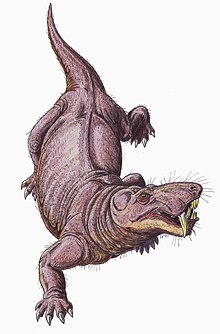
From my blog, The Last Lemurisian
Gorgonopsia, meaning 'gorgon face', were mammal-like, with heterodont teeth, ear bones and temporal fenetraes (skulls characterised by bilateral, symmetrical holes, or fenestraes, in the temporal bone.), though it's unknown whether they had scales, fur, or just naked skin. They're one of three groups of theradonts, and are a close relation to mammals, through cynadonts, another group of theradont.
There are 19 families of Gorgonopsia, and three subfamilies. The three subfamilies of Gorgonopsia are Gorgonopsinae, Inostranceviinae and Rubidgeinae, and contain three, two and four species respectively.
Gorgonops is the most common genus of Gorgonopsinae, that grew to 2-2.5 meters long, and had 12-cm sabre teeth, similar to smilodon. Gorgonops were faster than the majority of Gorgonopsinae because of their long legs under their body. There are three definitely known species of Gorgonops:
- Torvus, the type species. A medium-sized Gorgonops characterised by a longer snout and some difference in skull structure.
- Whaitsi, a larger Gorgonops, with a wider skull rear and details of proportion.
- Longifrons, a large Gorgonopsid with an larger skull-orbit and snout than Whaitsi.
There are three other species, though they're either uncertainly placed, or synonyms. These are dixeyi, kaiseri, and eupachygnathus.
Artist interpretation of Whaitsi
Torvus, by Theropsida
Longifrons, also by Theropsida
Gorgonops have been in popular culture a couple of times. In 2005, a Gorgonopsid was featured in Walking With Monsters, but was specified as a Gorgonops in the companion book, though as it was shown preying on a scutosaurus, it was likely a different genus of Gorgonopsid, as Gorgonops and scutosaurus lived in separate countries. It was also shown in the 2007-present ITV-sci-fi, Primeval twice.
Another Gorgonopsinae is Sauroctonus, a 3 meter long gorgonopsid with a triangular skull, and a primitive parietal eye. They had a pair of huge canines on the upper and lower jaws, larger on the upper jaw. Their other teeth were smaller and pointed, and tiny blunt teeth were found on the palatine bone. The lower jaw was widened to form a chin, and their long, lightly-built limbs resembled mammalian limbs. Despite having mammalian characteristics, they're not ancestors of mammals. There are two species of Sauroctonus, Parringtoni and progressus.
Artist impression of Sauroctonus
Another genus of Gorgonopsia is Scylacops, a moderately-sized relative of Progressus Sauroctonus, composed of two species, bigendens and capensis.

Scylacops bigendens, by theropsida
In the subfamily Inostranceviinae, the first genus is Inostrancevia. Inostrancevia had an upright posture of 1-4.3 meters long and strong muscular attachments. They had larger temporal fenestras and smaller eye sockets than less advanced therapsids. The upper jaw contained 10 small back teeth, 6 large incisors, and 2 larger canines. Their lower jaw was composed of 6 large incisors, and 8 small incisors.
An artist impression of an Inostrancevia and a scutosaurus
There are four species of Inostrancevia, Amalitsky, l. Pravoslavlev,Tatarinov, and v. Pravolsavlev.
Pravoslavlevia is another genus of Inostranceviinae. Only one species of Pravoslavlevia is known, Parva. Their total length was around 1.4 meters, making them a particularly small Gorgonopsid.
Artist impression of Pravoslavlevia Parva
The last subfamily of Gorgonopsidae is Rubidgeinae, and the first genus is Broomicephalus. They were small gorgonopsids with long, broad snouts, only about 1.1 meters in total.
Artist impression of Broomicephalus.
Niuksenitia is another genus of Rubidgeinae, but I can't find any information on it.
Prorubidgea is also a genus of Rebidgeinae, containing 6 species, Alticeps, Brinki, Brodiei, Maccabei, Pugnax and Robusta, but I couldn't find any more information on it.
The last genus is Rubidgea, a 2.4 meter gorgonopsid with very large canines, which contains one known species, Atrox.
Artist impression of Rubidgea Atrox.
There are another 19 families of Gorgonopsids, but I'm very tired, and have an exam in the morning. I may return to them, but for now, I do need to sleep.
From my blog, The Last Lemurisian
Wednesday, May 25, 2011
Rape is like getting a flat tire?
Kansas Representative Pete DeGraaf (Republican) is behind a new bill that has passed the state house and is expected to be signed into law by Governor Sam Brownback. This bill will ban insurance companies from covering abortions in any case other than when the women’s life is in danger. While separate ‘abortion policies’ will be allowed under the bill, it affectively makes abortions out of reach for a large percentage of the populace who would need them. This bill does not make expectation for cases or rape.
A fellow Republican Representative, Barbara Bollier who supports abortion rights questioned the rationality behind such a bill. She wondered whether women really should be expected to purchase abortion only policies to cover for what is always an unforeseen possibility. Be it for an unwanted pregnancy in general or for the case of rape victims. In a completely unexpected rebuttal, Representative DeGraaf responded with:
“
I really do not know what to say to this. How can anyone consider being violated in one of the most horrific ways as the same as the annoyance of getting a flat tire? If nothing else proves the inhumanity of such people, this certainly must.
A fellow Republican Representative, Barbara Bollier who supports abortion rights questioned the rationality behind such a bill. She wondered whether women really should be expected to purchase abortion only policies to cover for what is always an unforeseen possibility. Be it for an unwanted pregnancy in general or for the case of rape victims. In a completely unexpected rebuttal, Representative DeGraaf responded with:
“
We do need to plan ahead, don't we, in life?"
Bollier asked him, "And so women need to plan ahead for issues that they have no control over with a pregnancy?"
DeGraaf drew groans of protest from some House members when he responded, "I have spare tire on my car."
"I also have life insurance," he added. "I have a lot of things that I plan ahead for."
I really do not know what to say to this. How can anyone consider being violated in one of the most horrific ways as the same as the annoyance of getting a flat tire? If nothing else proves the inhumanity of such people, this certainly must.
Tuesday, May 24, 2011
All hail Cthulu!
While I could not stand the original version of this song, I think I could get used to the improved version.
Edit:
Thanks to the wonderful Misa Akane for finding this for me, sorry for forgetting this.
Edit:
Thanks to the wonderful Misa Akane for finding this for me, sorry for forgetting this.
Monday, May 23, 2011
How the firefly glows
Biolumination, the creation of light by living things, is an evolutionary strategy that has formed multiple times for different reasons. But in the case of the fireflies, or lightning bugs if you prefer (despite them not being members of the true bugs, but that was last post), the cause for all the ephemeral lights generally comes down to one thing, sex.
Members of the family Lampyridea, or as they are more commonly known, fireflies, are a group of beetles that have developed the ability to use light for communication. Being beetles, a good portion of their lives are spent underground as larvae feeding off of soft bodied invertebrates such as slugs, snails and earthworms. Even at the larval stage, the glowing abdomen can be found in some species if flipped on their back. In this instance, the firefly is taking use of a secondary purpose behind glowing known as an aposematic signal. This is a warning to all those who find it that, due to chemicals unrelated to illumination, the creature possesses a terrible taste. In this case, the use of light is quite similar to the bright colors of certain poisonous frogs.
The production of light, in both the larvae and the adults, occurs in the abdomen. Here, on the underside of the posterior abdominal segments, within specialized cells known as photocyes, a chemical reaction occurs that produces the light. In the case of fireflies (as there are many ways to produce light), they begin with a florescent substrate known as Luciferin. While Luciferin can produce some light when oxidized, fireflies use an enzyme known as Luciferase to speed up the reaction. While Luciferin on its own only produces one wavelength of light, changes to the shape of the Luciferase enzyme in different species allows for the production of the wavelengths of yellow, green and even red light.
The reactions use of oxygen is key to the fireflies control over its light. While the nervous system does not directly contact the photocytes, it does connect to nearby cells. When the firefly wants to light up, it sends a signal to these neighboring cells to start producing nitrous oxide which is then absorbed by the adjacent photocytes. The photocytes have arranged their mitochondria (the source of energy for a cell) along the outside so that oxygen is used up by them before it can react with the Luciferin produced within the cell. But once nitrous oxide starts to be absorbed, the mitochondria start to metabolize using this gas instead, allowing for oxygen to diffuse deeper into the cell where it can finally be used in the reaction to produce light. As long as the supportive cells produce nitrous oxide, enough oxygen will diffuse throughout the cells for the firefly to glow. But once the production of nitrous oxide stops, the mitochondria go back to using oxygen which interrupts the oxygen flow, preventing the light producing reaction. In this round about manner, the firefly can appear to flick on and off.
All of these complex pathways have evolved for the sake of sex. For when it comes to reproduction, evolution will take any and all possible paths it can so that the individual’s genes may be passed on. The flashing is used as a sign of fitness, the longer and brighter the flash, the better suited the mate. Many females, who often do not develop wings and may even stay in a permanent larval form, use their own light to signal to the males whether they are interested or not.
The color, frequency and duration of the flashes are unique to each species. This prevents an individual from trying to attract a mate only to find out that it is the wrong species. However, one genus has taken advantage of this distinction. Females of the genus Photuris will mimic the flashes of the females of members of a different genus, Photinus, to lure in incompatible males. Once lured in, the female Photuris will eat the unsuspecting male so that it might gain the toxins it produces. It seems Photuris has found a more efficient way of becoming inedible than just producing the chemicals herself.
Thank you JuneBug for the request!
Members of the family Lampyridea, or as they are more commonly known, fireflies, are a group of beetles that have developed the ability to use light for communication. Being beetles, a good portion of their lives are spent underground as larvae feeding off of soft bodied invertebrates such as slugs, snails and earthworms. Even at the larval stage, the glowing abdomen can be found in some species if flipped on their back. In this instance, the firefly is taking use of a secondary purpose behind glowing known as an aposematic signal. This is a warning to all those who find it that, due to chemicals unrelated to illumination, the creature possesses a terrible taste. In this case, the use of light is quite similar to the bright colors of certain poisonous frogs.
The production of light, in both the larvae and the adults, occurs in the abdomen. Here, on the underside of the posterior abdominal segments, within specialized cells known as photocyes, a chemical reaction occurs that produces the light. In the case of fireflies (as there are many ways to produce light), they begin with a florescent substrate known as Luciferin. While Luciferin can produce some light when oxidized, fireflies use an enzyme known as Luciferase to speed up the reaction. While Luciferin on its own only produces one wavelength of light, changes to the shape of the Luciferase enzyme in different species allows for the production of the wavelengths of yellow, green and even red light.
The reactions use of oxygen is key to the fireflies control over its light. While the nervous system does not directly contact the photocytes, it does connect to nearby cells. When the firefly wants to light up, it sends a signal to these neighboring cells to start producing nitrous oxide which is then absorbed by the adjacent photocytes. The photocytes have arranged their mitochondria (the source of energy for a cell) along the outside so that oxygen is used up by them before it can react with the Luciferin produced within the cell. But once nitrous oxide starts to be absorbed, the mitochondria start to metabolize using this gas instead, allowing for oxygen to diffuse deeper into the cell where it can finally be used in the reaction to produce light. As long as the supportive cells produce nitrous oxide, enough oxygen will diffuse throughout the cells for the firefly to glow. But once the production of nitrous oxide stops, the mitochondria go back to using oxygen which interrupts the oxygen flow, preventing the light producing reaction. In this round about manner, the firefly can appear to flick on and off.
All of these complex pathways have evolved for the sake of sex. For when it comes to reproduction, evolution will take any and all possible paths it can so that the individual’s genes may be passed on. The flashing is used as a sign of fitness, the longer and brighter the flash, the better suited the mate. Many females, who often do not develop wings and may even stay in a permanent larval form, use their own light to signal to the males whether they are interested or not.
The color, frequency and duration of the flashes are unique to each species. This prevents an individual from trying to attract a mate only to find out that it is the wrong species. However, one genus has taken advantage of this distinction. Females of the genus Photuris will mimic the flashes of the females of members of a different genus, Photinus, to lure in incompatible males. Once lured in, the female Photuris will eat the unsuspecting male so that it might gain the toxins it produces. It seems Photuris has found a more efficient way of becoming inedible than just producing the chemicals herself.
Thank you JuneBug for the request!
Subscribe to:
Posts (Atom)