Sunday, May 29, 2011

Gorgonopsia

One of my favourite suborders that has ever existed is the Gorgonopsids, a therapsid synapsid in the middle to late Permian, though, they were sadly extinct in the Permian mass extinction, the only theradont line to meet this end. There were many types of Gorgonopsid, the largest, inostrancevia, the size of a rhino, and due to the extinction of dinocephalias, because the top Permian predator.

Gorgonopsia, meaning 'gorgon face', were mammal-like, with heterodont teeth, ear bones and temporal fenetraes (skulls characterised by bilateral, symmetrical holes, or fenestraes, in the temporal bone.), though it's unknown whether they had scales, fur, or just naked skin. They're one of three groups of theradonts, and are a close relation to mammals, through cynadonts, another group of theradont. 

There are 19 families of Gorgonopsia, and three subfamilies. The three subfamilies of Gorgonopsia are Gorgonopsinae, Inostranceviinae and Rubidgeinae, and contain three, two and four species respectively. 

Gorgonops is the most common genus of Gorgonopsinae, that grew to 2-2.5 meters long, and had 12-cm sabre teeth, similar to smilodon. Gorgonops were faster than the majority of Gorgonopsinae because of their long legs under their body. There are three definitely known species of Gorgonops:

  • Torvus, the type species. A medium-sized Gorgonops characterised by a longer snout and some difference in skull structure. 
  • Whaitsi, a larger Gorgonops, with a wider skull rear and details of proportion. 
  • Longifrons, a large Gorgonopsid with an larger skull-orbit and snout than Whaitsi.
There are three other species, though they're either uncertainly placed, or synonyms. These are dixeyi, kaiseri, and eupachygnathus. 

Artist interpretation of Whaitsi 

Torvus, by Theropsida

Longifrons, also by Theropsida


Gorgonops have been in popular culture a couple of times. In 2005, a Gorgonopsid was featured in Walking With Monsters, but was specified as a Gorgonops in the companion book, though as it was shown preying on a scutosaurus, it was likely a different genus of Gorgonopsid, as Gorgonops and scutosaurus lived in separate countries. It was also shown in the 2007-present ITV-sci-fi, Primeval twice.  

Another Gorgonopsinae is Sauroctonus, a 3 meter long gorgonopsid with a triangular skull, and a primitive parietal eye. They had a pair of huge canines on the upper and lower jaws, larger on the upper jaw. Their other teeth were smaller and pointed, and tiny blunt teeth were found on the palatine bone. The lower jaw was widened to form a chin, and their long, lightly-built limbs resembled mammalian limbs. Despite having mammalian characteristics, they're not ancestors of mammals. There are two species of Sauroctonus, Parringtoni and progressus. 

Artist impression of Sauroctonus

Another genus of Gorgonopsia is Scylacops, a moderately-sized relative of Progressus Sauroctonus, composed of two species, bigendens and capensis. 


Scylacops bigendens, by theropsida

In the subfamily Inostranceviinae, the first genus is Inostrancevia. Inostrancevia had an upright posture of 1-4.3 meters long and strong muscular attachments. They had larger temporal fenestras and smaller eye sockets than less advanced therapsids. The upper jaw contained 10 small back teeth, 6 large incisors, and 2 larger canines. Their lower jaw was composed of 6 large incisors, and 8 small incisors. 

An artist impression of an Inostrancevia and a scutosaurus

There are four species of Inostrancevia, Amalitsky, l. Pravoslavlev,Tatarinov, and v. Pravolsavlev.

Pravoslavlevia is another genus of Inostranceviinae. Only one species of Pravoslavlevia is known, Parva. Their total length was around 1.4 meters, making them a particularly small Gorgonopsid. 

Artist impression of Pravoslavlevia Parva

The last subfamily of Gorgonopsidae is Rubidgeinae, and the first genus is Broomicephalus. They were small gorgonopsids with long, broad snouts, only about 1.1 meters in total. 

Artist impression of Broomicephalus.

Niuksenitia is another genus of Rubidgeinae, but I can't find any information on it. 
Prorubidgea is also a genus of Rebidgeinae, containing 6 species, Alticeps, Brinki, Brodiei, Maccabei, Pugnax and Robusta, but I couldn't find any more information on it. 

The last genus is Rubidgea, a 2.4 meter gorgonopsid with very large canines, which contains one known species, Atrox. 
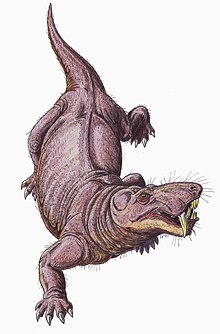
Artist impression of Rubidgea Atrox.

There are another 19 families of Gorgonopsids, but I'm very tired, and have an exam in the morning. I may return to them, but for now, I do need to sleep. 


From my blog, The Last Lemurisian
Facebook Digg Stumble Delicious Twitter Reddit Technorati

Wednesday, May 25, 2011

Rape is like getting a flat tire?

Kansas Representative Pete DeGraaf (Republican) is behind a new bill that has passed the state house and is expected to be signed into law by Governor Sam Brownback. This bill will ban insurance companies from covering abortions in any case other than when the women’s life is in danger. While separate ‘abortion policies’ will be allowed under the bill, it affectively makes abortions out of reach for a large percentage of the populace who would need them. This bill does not make expectation for cases or rape.

A fellow Republican Representative, Barbara Bollier who supports abortion rights questioned the rationality behind such a bill. She wondered whether women really should be expected to purchase abortion only policies to cover for what is always an unforeseen possibility. Be it for an unwanted pregnancy in general or for the case of rape victims. In a completely unexpected rebuttal, Representative DeGraaf responded with:

We do need to plan ahead, don't we, in life?"

Bollier asked him, "And so women need to plan ahead for issues that they have no control over with a pregnancy?"

DeGraaf drew groans of protest from some House members when he responded, "I have spare tire on my car."

"I also have life insurance," he added. "I have a lot of things that I plan ahead for."

I really do not know what to say to this. How can anyone consider being violated in one of the most horrific ways as the same as the annoyance of getting a flat tire? If nothing else proves the inhumanity of such people, this certainly must.
Facebook Digg Stumble Delicious Twitter Reddit Technorati

Tuesday, May 24, 2011

All hail Cthulu!

While I could not stand the original version of this song, I think I could get used to the improved version.


Edit:

Thanks to the wonderful Misa Akane for finding this for me, sorry for forgetting this.
Facebook Digg Stumble Delicious Twitter Reddit Technorati

Monday, May 23, 2011

How the firefly glows

Biolumination, the creation of light by living things, is an evolutionary strategy that has formed multiple times for different reasons. But in the case of the fireflies, or lightning bugs if you prefer (despite them not being members of the true bugs, but that was last post), the cause for all the ephemeral lights generally comes down to one thing, sex.

Members of the family Lampyridea, or as they are more commonly known, fireflies, are a group of beetles that have developed the ability to use light for communication. Being beetles, a good portion of their lives are spent underground as larvae feeding off of soft bodied invertebrates such as slugs, snails and earthworms. Even at the larval stage, the glowing abdomen can be found in some species if flipped on their back. In this instance, the firefly is taking use of a secondary purpose behind glowing known as an aposematic signal. This is a warning to all those who find it that, due to chemicals unrelated to illumination, the creature possesses a terrible taste. In this case, the use of light is quite similar to the bright colors of certain poisonous frogs.

The production of light, in both the larvae and the adults, occurs in the abdomen. Here, on the underside of the posterior abdominal segments, within specialized cells known as photocyes, a chemical reaction occurs that produces the light. In the case of fireflies (as there are many ways to produce light), they begin with a florescent substrate known as Luciferin. While Luciferin can produce some light when oxidized, fireflies use an enzyme known as Luciferase to speed up the reaction. While Luciferin on its own only produces one wavelength of light, changes to the shape of the Luciferase enzyme in different species allows for the production of the wavelengths of yellow, green and even red light.

The reactions use of oxygen is key to the fireflies control over its light. While the nervous system does not directly contact the photocytes, it does connect to nearby cells. When the firefly wants to light up, it sends a signal to these neighboring cells to start producing nitrous oxide which is then absorbed by the adjacent photocytes. The photocytes have arranged their mitochondria (the source of energy for a cell) along the outside so that oxygen is used up by them before it can react with the Luciferin produced within the cell. But once nitrous oxide starts to be absorbed, the mitochondria start to metabolize using this gas instead, allowing for oxygen to diffuse deeper into the cell where it can finally be used in the reaction to produce light. As long as the supportive cells produce nitrous oxide, enough oxygen will diffuse throughout the cells for the firefly to glow. But once the production of nitrous oxide stops, the mitochondria go back to using oxygen which interrupts the oxygen flow, preventing the light producing reaction. In this round about manner, the firefly can appear to flick on and off.

All of these complex pathways have evolved for the sake of sex. For when it comes to reproduction, evolution will take any and all possible paths it can so that the individual’s genes may be passed on. The flashing is used as a sign of fitness, the longer and brighter the flash, the better suited the mate. Many females, who often do not develop wings and may even stay in a permanent larval form, use their own light to signal to the males whether they are interested or not.

The color, frequency and duration of the flashes are unique to each species. This prevents an individual from trying to attract a mate only to find out that it is the wrong species. However, one genus has taken advantage of this distinction. Females of the genus Photuris will mimic the flashes of the females of members of a different genus, Photinus, to lure in incompatible males. Once lured in, the female Photuris will eat the unsuspecting male so that it might gain the toxins it produces. It seems Photuris has found a more efficient way of becoming inedible than just producing the chemicals herself.

Thank you JuneBug for the request!
Facebook Digg Stumble Delicious Twitter Reddit Technorati

Superfamily Pentatomoidea – The stink bugs

The insects known more commonly as the stink bugs, shield bugs or chest bugs are all members of the large superfamily Pentomoidea. There are approximently 7000 known species divided up amongst 14 to 15 families (depending on the system preferred by the consulted taxonomist). All are distinguishable by a similar body plan, the structure of their mouth parts and their varying use of chemical defenses.

Members of the true bugs (order Hemiptera), stink bugs are often mistakenly called beetles (order Coleoptera), despite having being members of a distinct order. While there are a number of anatomical differences between the true bugs and the beetles, one of the most distinctive can be seen in their mouth parts. Members of the true bugs all have modified their mouth parts into a sucking proboscis like structure. Composed of fused mandible and maxillae used for piercing and housed within a labium, most stink bugs use this proboscis to feed on the fluids of plants though a few species are predators of other insects.

Another distinct difference between true bugs and beetles can be seen in their wing structure. The beetle’s elytra (fore-wings) are entirely hardened and are not used for flight. These form a protective barrier for their alae (hind-wings). Both pairs of wings sit side by side and do not overlap, as they are in the true bugs. The true bugs also either have fully membranous wings or partially hardened elytra. In the case of true bugs with partially hardened elytra, the alae will be membranous, but many true bugs with membranous elytra will posses either reduced or completely lack their alae.

The final primary difference can be seen in their life cycle. Beetles are endopteryotes, meaning they go through a complete metamorphosis from a larval stage where as the true bugs are hemimetabolous and, after hatching, their young often appear as under-developed adults, known as nymphs. Often lacking wings until being gained during a molting (the most well known case of this, and also a member order Hemiptera, is the cicada) stink bug nymphs still possess the ability to produce the noxious chemicals found in the adults, though sometimes in a less developed way.

All members of superfamily Pentomoidea (which gets its name from these insects trade-mark 5 segmented antennae) either have a rounded or somewhat triangular body plan. Most in North America are more familiar with the angular body plan, but both forms are common. One of the easiest ways to tell if you are dealing with a member of this superfamily (other than the often nauseating odor when they are disturbed) is their well developed scutellum. This is a hardened extension of the thorax that covers the abdomen and protects part of the insect’s body and its wings, it is also the source of the common names ‘shield bug’ and ‘chest bug’. The scutellum is often mistaken as the hardened fore-wings of the beetles despite not being a part of the wing structures. Instead, the fore-wings are partially hardened and leathery to cover the membranous hind-wings, which are the primary source of flight. This combination of hardened and membranous wings gives the insect its characteristic buzzing sound while in flight.

Because of many stink bugs feeding off of the fluids of plants, many are considered major agricultural pests. A prime example of this can be seen with the introduction of the Brown Marmorated Stink Bug (Halyomorpha halys) to the North-Eastern United States from various parts of East Asia where it is also a common agricultural pest. First spotted in 1988, this species has quickly spread and now threatens crops as diverse as apples, sweet corn, peaches, soy beans, blackberries and others. Besides the damage to crops, many species of stink bugs are also common household pests where their repulsive sent makes many homeowners unsure of how to remove them without causing the insects to release their defensive chemicals. Despite being a common pest, some stink bugs are desirable due to their predatory nature, often feeding off of insects considered pests themselves.

The Brown Marmorated Stink Bug.


Many stink bugs take advantage of a survival technique known as clustering. This occurs when multiple insects congregate to increase their chances of survival as a group and, in some species, to mate. This form of aggregation is often aided by pheromones many species use to attract other individuals and mates. If these pheromones are present, they are typically produced by exocrine glands on the abdomen. It seems a wise maneuver to move in numbers when many animals are afraid to take on one insect, let alone risk a potential sudden cloud of terribly smelling chemicals.

But I’m sure what many of you have been waiting to read involves the source of their most common of names. This has to do with a defensive measure that most members of superfamily Pentatomoidea share to one degree or another, the use of chemical weaponry. Housed in special glands found on either side of the thorax, these insects emit of spray of odiferous chemicals. The nature of these chemicals varies from specie to specie with the most common derivatives being alcohols, aldehydes and esters. In a few species, the compound is based off of cyanide and has the poison’s trademark almond like scent, though despite being based on a potent toxin, exposure is not fatal to humans. It should be noted that there are a few insects that also posses foul smelling chemical defences that have no relation to the true stink bugs. These include the pinacate beetles (genus Eleodes) and the Box Elder Bug (Boisea trivittata) amongst others.

While few can tolerate the rancid smell if allowed to spray, some people have found another use for these pungent insects. As astonishing as it might sound for an insect notorious for its scent, many stink bugs are used in various cuisines from around the globe. Most commonly eaten in Vietnam, Laos and Mexico, they are often prized for their strong flavor.

Thank you Holte Ender for the request!
Facebook Digg Stumble Delicious Twitter Reddit Technorati

Saturday, May 21, 2011

It’s the end of the world as we know it…


Well now that I have gotten the tune to a song that no one can properly hope to sing stuck in your head, it is time to celebrate the end of the world!

But what should you expect on the rapture?  Well one thing to keep in mind is if you go out, be sure to wear a rain coat.  Why you might ask?  Just think of how much mess a flock of birds flying overhead can make and imagine how much worse it would be with a group of humans scared shitless (quite literally) by their sudden loss of gravity. 

You should also expect to have massive cancellations of flights.  After the first two or three planes experience in flight emergencies after their engines get clogged up with bits of Christian chunks, flights everywhere will be grounded until the sky-lanes finally clear of the flocks of believers.

The believers that make it past the airplanes will have a few other things to contend with.  The first is the fact that oxygen levels and temperatures quickly begin to drop the higher up in the atmosphere you get.  Soon the excited believers will begin to become panic stricken once they realize that the writers of the bible had a very poor grasp of the fundamentals of our planet.  I imagine god will be pretty embarrassed when he goes out to greet the first of his chosen only to find them as lifeless meat-sicles. 

The various space agencies are likely also to be rather pissed by god’s oversight.  Our planets orbit is already littered with bits of space junk that perpetually threaten the many artificial satellites that help maintain our modern life.  All they need is a few thousand more things to track, not to mention the disruption of the amazing view those on the International Space Station has after it becomes obscured with the morbid vista of countless bodies drifting past.

Of course it is also possible that this entire thing is the creation of a series of deluded minds attempting to interpret the ramblings of ignorant ancient desert dwellers as absolute truth and nothing more than a lot of embarrassed back-tracking from the die-hard believers will come of this.  Perhaps there will even be an explosion of people coming to their senses about all this rapture business with former believers realizing that their invisible sky daddy is nothing more than a silly myth that should have been set aside with the likes of the tooth fairy.  People might learn from the error of their petty divisive beliefs and attempt to more forward as a more unified society.  On second thought, we should all probably just be on the lookout for someone claiming to have uncovered the ‘real’ date of the rapture for the believers to cling on to.
Facebook Digg Stumble Delicious Twitter Reddit Technorati

Friday, May 20, 2011

Class Holothuroidea, the Sea Cucumbers

The sea cucumber Bohadschia argus

Echinoderms, in general, are an often overlooked group of creatures.  Other than for being ubiquitous members of tidal pools and the ocean floor, your average person knows little about them.  One class in particular, Holothuroidea, is generally seen as just a curiosity despite having a series of downright bizarre traits and behaviors.  Commonly known as the Sea Cucumbers due to their cylindrical appearance, these scavengers can be found in every ocean.  Not only are they indigenous to all oceans, many species travel in herds that can reach numbers well over a thousand.

Like other living echinoderms such as sea stars, urchins, brittle stars and crinoids, sea cucumbers posses what is known as pentaradial symmetry.  This means that their body plan can be split into five equal sides.  At first sea cucumbers seem to break this rule, but that is only when looked at from above.  When observed on end, the pentaradial symmetry is easily distinguishable.  What appears to be bilateral symmetry at first glance is an intriguing illusion when you take into consideration that all echinoderms evolved from a common ancestor that possessed bilateral symmetry, a feature that is only shown in modern day larval forms. 

Your average sea cucumber feeds by sucking up ocean sediment like a living vacuum cleaner.  Using feeding tentacles, they pick through the sediment and the remaining substrate is passed out the opposite end.  A few species will go so far as to extend their feeding tentacles to pick pieces of food out of the passing current they position themselves near.  There is also one species that gains its nourishment through a commensal relationship with deep-sea angler fish, though little is known about this relationship. They generally propel themselves along on 8-30 small tube feet that make use of echinoderms trademark water vascular system which is essentially a body wide hydraulic system.  One subclass, Apodacea, has gone so far as to completely lose their tube feet and instead burrows through sediment with a series of muscular contractions along their body.

All sea cucumbers have an endoskeleton, but in most, it has become greatly reduced to little more than small ossicles sparsely numbered throughout the mesoderm.  A few species have adopted hardened calciferous plates covering their body for protection, but it is not common.  This leaves most sea cucumbers with a rather soft texture that makes one wonder what sort of cucumbers the person was eating who granted these creatures their common name.  Many sea cucumbers make perfect use of their squishy bodies when it comes to getting into tight spaces.  Their body tissues contain a modified form of collagen known as catch collagen.  In most animals, this provides tissues with a flexible, but strong nature by forming a network of interconnected proteins.  Sea cucumbers have modified this protein so that they can become viscous at will allowing them to literally pour their tissues through a tight crevice.  Once in, they can let their catch collagen reconnect, reforming their tissues into the orderly form it once was.

As if turning themselves to liquid wasn’t odd enough, members of the order Aspidochirotida have a somewhat…unsettling defense mechanism.  They turn their anus at an attacker and through a tear between the coelom (body cavity) and cloaca (the common opening for the intestinal, urinary and reproductive tracts), they expel their respiratory tree which is coated in toxins and a sticky material.  This process, known as evisceration, ensnaring the would be predator in what one can only compare to the most nauseating imitation of Spider-Man ever.

One would think having the ability to spew toxic innards out of one’s ass would keep any sane creature away, but one peculiar fish is not detered.  Known as the pearlfish, many members of the family Carapidae make their home within the confines of the sea cucumber’s cloaca.  These slender fish often cause no harm or benefit to their host and simply use the space to remain hidden within.  A few species have been known to…ahem…eat out the sea cucumber, but this behavior is rare.  A few members of pearlfish have found their home so comfy they invite in their mate.  In a disturbing twist, the pearlfish uses the reproductive space of the sea cumber as its own love abode.

For the most part, sea cucumbers possess few traits useful to humans, though the flesh of some species is eaten in certain oriental cuisine.   Sea cucumbers have also been a staple of traditional Chinese medicine for generations, though the effectiveness is debatable.  A study single has suggested that the fatty acids found in sea cucumber tissue could play a role in tissue repair, but the actual use was never tested.  Another study found an extract could be useful for internal pain when studied on mice, but there was no effect when applied for external pain leaving the validity of the study in doubt.  Finally, a recent study concluded that the Lectin protein (used in the binding of sugar) found in the species Cucumaria echinata actually inhibited the growth of the Malaria parasite.

Most sea cucumbers are dioecious, meaning they have separate male and female sexes.  A few species are protandric, which allows members of one sex transform themselves over to the other sex at one or more points in their life.  The average life cycle involves mass spawning into the current with the ensuing zygote and eventual larvae joining the planktonic drift.  About 30 species, however, fertilize internally.  Once the egg hatches, a feeding tentacle grabs the larva and moves it into a brood pouch for development.  Here they grow to maturity and either crawl out from where they entered or make a rupture out the back end near the anus.  This explosive birth is not fatal to the adult who possesses astonishing regenerative capabilities (after all, if they can re-grow their ‘lungs’ a hernia should pose few problems).

This article was written at the request of one of my readers over at Mad Mikes America.  Anyone who would have a request for an article, feel free to either leave the request in the comments section.  Thank you Morgan Williams for your request!
Facebook Digg Stumble Delicious Twitter Reddit Technorati