Showing posts with label paleontology. Show all posts

Tuesday, February 14, 2012

The song of Archobollus musicus

ResearchBlogging.org Within a sparsely populated coniferous forest, night is quickly approaching.  As twilight pushes on and the sun slowly disappears from the horizon, the nocturnal singers of the forest begin to awaken.  Joining the choir of amphibians and other mistrals of the night a lone katydid begins to play its chirping melody.

Staying low to the ground, the katydid hides amongst the foliage of the giant fern Caniopteris.  It sings its song as it scrapes its wings together, passing one along the rides of the other.  Quieting down only when a small mammal or dinosaur becomes too curious about the source of the ethereal sound.  A scene that would play out nightly for millions of years.

For, like the katydid, the forest died long ago.  But in the mid-Jurassic, both thrived in what is now northwest China.  This particular katydid, known as Archabollus musicus belonged to a family known as Haglidae, a group of Orthopterans that existed from the early Triassic until ultimately becoming extinct in the late Cretaceous.

Orthoptera is the order of insects that includes all crickets, grasshoppers, locusts and katydids.  Like so many of its now living relatives Archabollus musicus produced sound through the process of stridulation (the action of creating sound by the rubbing together of the wings or the legs).  This process can produce one of two types of sound, resonant or non-resonant.  The non-resonant producing insects create a wide variety of tones where as the resonant, or musical insects, produce pure-tones.  A. musicus was a member of the later and more ancestral group, producing a resonant sound at 6.4 khz, well within the threshold for human hearing.

One might wonder how we can know the specific frequency of sound produced by an insect that lived 165 million years ago.  The answer comes from a particularly well preserved fossil recently unearthed.  In it, the wing is so well preserved that the stidulatory file, the series of ridges along one of the wings that the other wing scrapes along to produce sound, is almost perfectly preserved.

As the plectrum, the appendage that scrapes along the file, passes over each tooth, the resulting vibrations produce sound.  The shape and spacing of the teeth dictate the kind of sound that will be produced, just like how the sound of running your thumb over different combs produce different sounds.  And just like with combs, how fast the plectrum passes over the stidulatory file affects what kind of sound will be produced.  Based on the shape and size of the teeth, there is a specific speed that produces the optimum tone.

The fossil wing of Archabollus musicus next to a representation of the stridulatory file.
Using this knowledge, Fernando Montealegre-Zapata of the University of Bristol in the UK and his colleges Jun-Jie Gu, Daniel Roberts, Michael S. Engel, Ge-Xia Qiao, and Dong Ren were able to begin work on reproducing the sound of this long extinct katydid.

From the cavernous expanse of deep time, a sound that has not been heard upon this Earth for 165 millions years begins to resonate.  It is a sound both familiar and haunting.  While it is a simple sound, it is one that deserves respect and elicits awe.  It is the sound of our own curiosity and ingenuity.  It is the sound of beauty.


-----------------------------------------------------------------------------------------------
References:
Gu, J., Montealegre-Z, F., Robert, D., Engel, M., Qiao, G., & Ren, D. (2012). Wing stridulation in a Jurassic katydid (Insecta, Orthoptera) produced low-pitched musical calls to attract females Proceedings of the National Academy of Sciences DOI: 10.1073/pnas.1118372109
Facebook Digg Stumble Delicious Twitter Reddit Technorati

Friday, February 10, 2012

Earliest animal fossil was the size of a grain of rice.

ResearchBlogging.org During the Cryogenian, a tiny organism began to spread across the shallow seas.  750 to 550 million years ago, these tiny organisms, just  0.3 to 5mm in length became a dominant force in the ancient oceans.  But despite their size, their importance cannot be underestimated.  For they are the oldest animals to be discovered, predating any other animal fossil by 100 to 150 million years.
Scanning Electron Microscopy of Otavia antiqua taken from the Kuibis Subgroup of the Zaris Formation near Kliphoek in southern Namibia.
Given the name Otavia antiqua and found in the oldest rocks in Namibia, they show that animal life has it roots much further in the past then had been previously expected based upon earlier fossil evidence.  They thrived during a time known as the Cryogenian, the second period of the Neoproterozoic that lasted from of 830 to 635 million years ago.  A period that gains its name from two events where global temperatures plummeted causing the most extensive glaciation events in our planets history, known as the Snow Ball Earth events. During these occurrences glaciation covered most, if not all of the planet, if the hypothesis is correct that is.

The earliest Otavia a. fossils predate the first of the two predicted glaciation events, known as the Sturtian.  Fossils persist up until till the end of Precambrian, where the rise in numbers of complex animals truly begins.  They were simple animals, believed to be Poriferans, sponges.  They have most of the features shared by modern sponges with the exception of spicules (shards of hardened material that are produced by the sponge for structural support), though they may have possessed these too but due to their tiny size and ancient age, little trace is left of them.

They had a very simple body plan.  Most were ovoid to globular in appearance with three distinct sections.  The outer layer was covered in many small pores, known as ostia with a size of 5 to 20 microns in diameter.  These let water into the second section, the peripheral labyrinth.

This section most likely allowed for the start of absorption of nutrients via consumption of algae and bacteria, making Otavia a simple, if sessile, predator.  This section lived up to its name with many winding passages, allowing for the most surface area, increasing nutrient absorbtion as well as gas exchange.

Water would then pass into the central chamber that made up the majority of the internal space of the animal.  This spongocoel (called a paragastric chamber in the paper) would have, most likely, been lined with choanocytes, just as the peripherial labyrinth would have been.

These cells, common to all sponges, beat the water with their flagellum to create a current to aid in respiration and bring in new nutrients.  Water is then evacuated from the spongocoel through the largest opening, known as the osculum.  In Otavia, this opening would have attained a size of many tens of microns in diameter in the larger individuals. 

Otavia also features a trait common to most sponges, mineralization.  While the exact mineral is still in question, Calcium Carbonate or Dolomite are the two most likely suspects based on the composition of Otavia fossils.  This shows that by the time these tiny sponges evolved, they had already begun mastering the process of depositing minerals within their internal structure to provide a more rigid structure.  In essence, the earliest evidence for something akin to a skeleton.  While non-living and quite different from the skeletons that would emerge later within the animal kingdom, it still sets a precedent.

The genus name for these tiny creatures comes from the rock structure where the most specimens were discovered, and by chance, the oldest known individuals.  They were removed from a black limestone portion of the Otavi Group of Namibia.  Combined with the other rock structures that Otavia specimens have been recovered, over a thousand fossils have been recovered, suggesting that they were an incredibly successful group.

While the emergence of these creatures predates the occurrence of any other animal fossil by at least a hundred million years, the discovery was not totally unexpected.  In what is sure to become yet another famous success story in the field of molecular biology, the first animals were predicted to have a common ancestor at exactly the time period when Otavia dominated.

Using a process known as a molecular clock, genomes of various organisms are compared to one another to look for both commonalities and how far apart various genes are.  By understanding just how differences in genes arise through evolution, we can look into the deep past and predict when organisms shared their last common ancestor.  These predictions have been supported by fossil evidence time and time again.  The emergence of Otavia at precisely the time when the last common ancestor of all metazoans was predicted to have lived, suggesting that it may very well be the ancestor of all modern animals, or lived along side it.

This suggests that we owe our very existence to an organism hardly the size of a grain of rice.  A rice grain that survived some of the most hostile climatic changes that our planet has ever experienced, allowing for the vast array or animals seen today to differentiate and spread into every ecosystem on the planet.

---------------------------------------------------------------
References:

Brain, C., Prave, A., Hoffmann, K., Fallick, A., Botha, A., Herd, D., Sturrock, C., Young, I., Condon, D., & Allison, S. (2012). The first animals: ca. 760-million-year-old sponge-like fossils from Namibia South African Journal of Science, 108 (1/2) DOI: 10.4102/sajs.v108i1/2.658
Facebook Digg Stumble Delicious Twitter Reddit Technorati

Sunday, May 29, 2011

Gorgonopsia

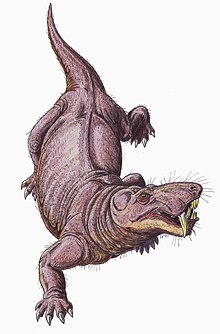
One of my favourite suborders that has ever existed is the Gorgonopsids, a therapsid synapsid in the middle to late Permian, though, they were sadly extinct in the Permian mass extinction, the only theradont line to meet this end. There were many types of Gorgonopsid, the largest, inostrancevia, the size of a rhino, and due to the extinction of dinocephalias, because the top Permian predator.

Gorgonopsia, meaning 'gorgon face', were mammal-like, with heterodont teeth, ear bones and temporal fenetraes (skulls characterised by bilateral, symmetrical holes, or fenestraes, in the temporal bone.), though it's unknown whether they had scales, fur, or just naked skin. They're one of three groups of theradonts, and are a close relation to mammals, through cynadonts, another group of theradont. 

There are 19 families of Gorgonopsia, and three subfamilies. The three subfamilies of Gorgonopsia are Gorgonopsinae, Inostranceviinae and Rubidgeinae, and contain three, two and four species respectively. 

Gorgonops is the most common genus of Gorgonopsinae, that grew to 2-2.5 meters long, and had 12-cm sabre teeth, similar to smilodon. Gorgonops were faster than the majority of Gorgonopsinae because of their long legs under their body. There are three definitely known species of Gorgonops:

  • Torvus, the type species. A medium-sized Gorgonops characterised by a longer snout and some difference in skull structure. 
  • Whaitsi, a larger Gorgonops, with a wider skull rear and details of proportion. 
  • Longifrons, a large Gorgonopsid with an larger skull-orbit and snout than Whaitsi.
There are three other species, though they're either uncertainly placed, or synonyms. These are dixeyi, kaiseri, and eupachygnathus. 

Artist interpretation of Whaitsi 

Torvus, by Theropsida

Longifrons, also by Theropsida


Gorgonops have been in popular culture a couple of times. In 2005, a Gorgonopsid was featured in Walking With Monsters, but was specified as a Gorgonops in the companion book, though as it was shown preying on a scutosaurus, it was likely a different genus of Gorgonopsid, as Gorgonops and scutosaurus lived in separate countries. It was also shown in the 2007-present ITV-sci-fi, Primeval twice.  

Another Gorgonopsinae is Sauroctonus, a 3 meter long gorgonopsid with a triangular skull, and a primitive parietal eye. They had a pair of huge canines on the upper and lower jaws, larger on the upper jaw. Their other teeth were smaller and pointed, and tiny blunt teeth were found on the palatine bone. The lower jaw was widened to form a chin, and their long, lightly-built limbs resembled mammalian limbs. Despite having mammalian characteristics, they're not ancestors of mammals. There are two species of Sauroctonus, Parringtoni and progressus. 

Artist impression of Sauroctonus

Another genus of Gorgonopsia is Scylacops, a moderately-sized relative of Progressus Sauroctonus, composed of two species, bigendens and capensis. 


Scylacops bigendens, by theropsida

In the subfamily Inostranceviinae, the first genus is Inostrancevia. Inostrancevia had an upright posture of 1-4.3 meters long and strong muscular attachments. They had larger temporal fenestras and smaller eye sockets than less advanced therapsids. The upper jaw contained 10 small back teeth, 6 large incisors, and 2 larger canines. Their lower jaw was composed of 6 large incisors, and 8 small incisors. 

An artist impression of an Inostrancevia and a scutosaurus

There are four species of Inostrancevia, Amalitsky, l. Pravoslavlev,Tatarinov, and v. Pravolsavlev.

Pravoslavlevia is another genus of Inostranceviinae. Only one species of Pravoslavlevia is known, Parva. Their total length was around 1.4 meters, making them a particularly small Gorgonopsid. 

Artist impression of Pravoslavlevia Parva

The last subfamily of Gorgonopsidae is Rubidgeinae, and the first genus is Broomicephalus. They were small gorgonopsids with long, broad snouts, only about 1.1 meters in total. 

Artist impression of Broomicephalus.

Niuksenitia is another genus of Rubidgeinae, but I can't find any information on it. 
Prorubidgea is also a genus of Rebidgeinae, containing 6 species, Alticeps, Brinki, Brodiei, Maccabei, Pugnax and Robusta, but I couldn't find any more information on it. 

The last genus is Rubidgea, a 2.4 meter gorgonopsid with very large canines, which contains one known species, Atrox. 

Artist impression of Rubidgea Atrox.

There are another 19 families of Gorgonopsids, but I'm very tired, and have an exam in the morning. I may return to them, but for now, I do need to sleep. 


From my blog, The Last Lemurisian
Facebook Digg Stumble Delicious Twitter Reddit Technorati

Monday, May 2, 2011

300 million year old fossil fish brain discovered

Though it is rare, soft tissue does fossilize under the right conditions. However brain tissue rarely does due to its high water content. As such, researchers have to rely on the shape of the brain case of well preserved specimens. But recently, a preserved brain was discovered within the fossil skull of a fish known as an Iniopterygian, specifically, a member of the genus Sibyrhynchus. These unusual cartilaginous fish were most closely related to the modern Chimeras and lived from the Devonian to the Carboniferous. They had large, dorsally situated pectoral fins that were thought to be used to 'fly' through the water as well as possibly in mating. This discovery marks the oldest known fossil of any brain, or as I like to call it, the oldest bit of zombie rock candy.


The fossil skull was found in Kansas in pristine shape. Many have already noted the irony of finding such an important fossil, especially considering that it is in the form of a brain, within a state with some of the highest percentages of creationists in the country.

Many fossils become flattened due to the pressures of the rock above, but in some cases, non-compressed fossils are found. In these instances, the samples are sent off for imaging to determine the internal structures of the specimen and in hopes of finding some hidden goodies. Upon being taken to European Synchrotron Radiation Facility (ESRF) a type of industrial grade CT scan, known as x-ray synchrotron microtomography was performed. This technique revealed a denser structure within the brain case, prompting to researchers to try a newer technique designed to reveal finer structures as well as put the specimen in a flashy 3-D view. This technique, know as X-ray holotomography revealed the fossilized brain in all its glory.

With this discovery, many are wondering if fossil brains could be more common but have been overlooked due to imprecise imaging techniques. If this is so, a more detailed understanding of the evolution of the brain may be possible.
Facebook Digg Stumble Delicious Twitter Reddit Technorati