Showing posts with label book review. Show all posts

Monday, February 21, 2011

I finally gain a little Common Sense

After years of having it on my to do list, I finally got around to reading Thomas Paine's Common Sense (and yes, I do know how groan inducing the title is, but I could not help myself). The reason for the long delay in doing so was partly my not coming across a copy for quite a while and when I did finally locate one, I had a few other things already in line to read.

I do find it odd that, throughout the years of American history courses I have taken, this has never been required reading. From all those years the only way it was ever mentioned was as an important pamphlet that argued for the American Revolution. No parts were ever shown from it, just that mention. I find that rather sad when you consider how much of an influence it really had in helping to sway the minds of so many towards the American cause, both foreign and domestic. It is made worse after one has actually read it as it helps to lay a better understanding of the situation then I have ever gained from any history course. One cannot help but see both the events and the timing of them (for which Paine argues considerably) as inevitable. As he states, any earlier and the colonies would not have had a sufficiently strong internal support system. Had it been any later, the few military minds left over from the French-Indian War would have died leaving the country without any war time knowledge.

Now I can see some possibly being put off by what they may see as religious connotations within this pamphlet. It is true there are myriad references to the bible and God, but these are not arguments for or against such things (as Paine notes). They are, instead, relics of the time and imagery of convenience. The first being due to the fact that even for non-believers of the Western world (Paine was a deist), the bible was still seen as a historical text. Yes, many discounted the religious aspect and instead payed attention to its genealogies and accounts of empires long since lost to time (for those that actually existed that is). One must also remember that an alternative was not available so even those who doubted its full historical and religious accuracy, were left with no other real alternative to go by. So it is no real surprise that he would reference the Christian bible.

This context is taken further when combined with the imagery Paine uses. This has specifically to do with the audience he intended this pamphlet for. He used a writing style, that while elegant and rich in thought, was of a form that would be accessible to all, from the common man to the elite. He knew that essentially all those who would read it would have one form of education in common, a religious one. He also knew that such arguments would appeal to those from all walks of life. But even more so, he knew that such writing would spur in his audience even more of a passion to see his point of view. Granted, as the title states, he intended what he wrote to be common sense, but he also knew that common sense was not always as common as it should be. He also recognized that using any way one might to go about livening things up to sway those who were still undecided about the matter could only help his argument and the cause.

The copy I purchased also has an added bonus of containing his response to a piece published by certain members of the Quaker community (The ancient testimony and principles of the people called Quakers renewed, with respect to the King and Government, and touching the commotions now prevailing in these and other parts of America addressed to the people in general...apparently short titles was not this particular authors forte). In the piece Paine addresses, the Quaker authors argue that the American people should not rise to arms due to certain biblical passages that stated that those in power are allowed to be so by God and that it is the people's responsibility to obey that authority as well as a passage from Proverbs that states "When a man's way pleases the Lord, he maketh even his enemies to be at peace with him".

Quite obviously, Paine was not pleased with such statements and his reasoning included the fact that every single ruler throughout history has gained power by the acts of people, often at the edge of a sword. If this were true, then how can it be the Lord's will for people to follow their current leader? For if this were true (in a religious sense of course), then any attempt to remove or replace said ruler would be stopped by their god. But since this has never occurred, then, based on their own logic, such actions must be the very will of their god to begin with. He further demolishes other parts of their argument by stating that they do not wish to depose a ruler, nor do they wish to establish a new monarch but be removed from the entire process. Not to mention that what they would be doing would be an act of defense, not offense, for it was the British who were seen to have started the whole affair through their neglect of the will of the American people.

He states that he has nothing against the Quakers at all, and is sure to make a defense of them so that none would take his words as a reason to mistreat the group as a whole or for anyone to consider removing any of their civil or religious freedoms. His argument came down to that those who wrote this piece were not acting according to their own doctrine, therefor their entire argument was invalid and and insult to Quaker society as a whole. He closes his letter with two lines that I believe should be more widely known and espoused, especially in light of certain religious groups active today. The first being:

Because it tends to the decrease and reproach of all religion whatever, and is of the utmost danger to society, to make it a party in political disputes.

The second (and my personal favorite) being the final line of his letter:

...but that the example which ye have unwisely set, of mingling religion with politics, may be disavowed and reprobated by every inhabitant of America.
Facebook Digg Stumble Delicious Twitter Reddit Technorati

Thursday, February 17, 2011

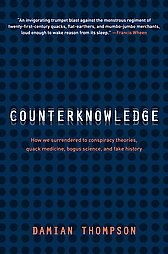
Counterknowledge: How We Surrendered to Conspiracy Theories, Quack Medicine, Bogus Science, and Fake History


In Counterknowledge: How We Surrendered to Conspiracy Theories, Quack Medicine, Bogus Science, and Fake History, Damian Thompson takes us through a quick trip through all the things around us that make people like me irritable. From Creationists trying to push their way into science classrooms to 9/11 "Truthers" and every ire inducing bit of idiocy in between.

While reading this book I found myself frequently shouting things like 'idiots', 'science doesn't work that way', 'my species is doomed' and other such inspiring lines. This is not because what Damian Thompson has written is absurd or wrong. No, it is because he has collected so many sources of disinformation together to be put on display. It is almost like a natural history of so many stupidly wrong and stubbornly pernicious ideas.

If you have ever wondered how that blunt force head trauma of a book The Secret ever got to be so popular or how rampant Islamic Creationism is and just how it is affecting the world, then you have found your one stop source of willful ignorance. While many of the topics may be familiar to those who are more familiar with the ways of the gullible masses, it is still nice to be able to see how such masses of ignorance could form.

Thankfully Damian Thompson has quite the sharp wit and has no qualms about using it on his chosen subjects. As this gives the reader that sense of not being alone in the vortex of idiocy that is our modern world. And with all the stupid he guides you through, you are going to need it.
Facebook Digg Stumble Delicious Twitter Reddit Technorati

Sunday, February 13, 2011

Parasite Rex: Inside the Bizarre World of Nature's Most Dangerous Creatures


I had been looking forward to reading through this book as soon as I had acquired it. While I had just read a book by this author, Carl Zimmer, I went ahead anyway and selected it from my collection (AKA: the towering pile of books were my body will one day be found, crushed). I have to admit that I have a bit of a fascination with the concept of a parasite. An organism that has adapted itself to live off of or within another organism. Such specialized examples of evolution have always caught my attention.

In this book Carl Zimmer reveals a truth about life that is often overlooked or perhaps purposely ignored. The fact that the number of parasite species are not some minority of organisms but in fact makes up the majority of species. For those of us living in the developed world, parasites have been moved to an oddity of underdeveloped regions. But humanities evolution has been shaped by parasites. Not just humanity but so much of the courses of evolution have been affected by parasites. Carl Zimmer even puts forth a recent argument that has developed that has parasites being the reason life evolved sex. Another shows that the various displays found in nature for attracting mates, such as the peacock's tail feathers or the dewlap of many lizards, are in fact displays to show that they are the most resistant to parasites (how else could they expend their energy this way when it would otherwise be siphoned off?). Suddenly all of evolution starts to show the signs of parasitic influence.

Parasites have found their way into every life form for so long that not having parasites is actually something out of the ordinary. In fact without parasites to keep in check, the human immune system that evolved alongside countless invaders can even go into overdrive in their absence. Such reactions display as allergies, colitis, and Crohn's disease.

Not only are parasites an accepted part of life for, well, the rest of life as a whole, it is a crucial one. When an ecosystem is unhealthy, it is the parasites that are affected first as they are the de facto top predator and thus they are hit the hardest when an ecological web is disturbed. Researchers are now starting to use the number of parasites as a sign of the health of an ecosystem, as if they are thriving then all the other strands must be in order. In many places the parasites act as a regulating system so that no one species ever becomes so successful that it pushes the ecosystem out of balance.

In all, Parasite Rex was a book that made me glad for once that I'm an insomniac as I was not willing to stop reading even if sleep is something humans are supposed to require. The way it has expanded my understanding of the intricate interactions of life on this planet is something that shall forever shape my view. It is like having a key piece of the puzzle put into place that you did not even know was missing.
Facebook Digg Stumble Delicious Twitter Reddit Technorati

Saturday, January 29, 2011

Microcosm: E. coli and the New Science of Life

I'm a bit of a bibliophile, I cannot resist picking up a potentially fascinating book. I've actually lost count of how many I have and doubt I'll ever have a working number. My collection is considered a bit odd as it is almost entirely non-fiction (my collection is big enough that I've given lists to local professors to compliment the rather sad science section of the library). While I do enjoy a well written story I generally prefer to come away from a book knowing more about a subject than when I picked it up. As such I've decided I might as well start reviewing some of them here. To start out with, I'll go over the one I've most recently finished Microcosm: E. coli and the New Science of Life by Carl Zimmer.

To start out with I would like to explain how I got my copy. I had ordered it online as a used copy through either Amazon or Half.com, I cannot remember which. It was being sold for only a couple dollars because it was not only used but there was some writing inside of it. This honestly did not bother me as I was just happy to get a copy at such a good price. When I received it in the mail I opened it up to see the condition. The dust cover has a minor tear, but everything else seemed in good order. I then go looking for this writing, thinking it will be just some notes. I find this not to be the case. The writing that made the seller think it was now junk turned out to be the author's signature! Apparently when Carl Zimmer released this book, he signed a limited number of first editions. I just happened to somehow wind up with one of those all thanks to someone else's ignorance.

The book itself was a wonderful read. I started reading while taking a Microbiology course and in the end, learned more from the book then I ever did in class. Granted, I am the kind who learns better on my own then through traditional classes, but the difference was still significant.

Carl Zimmer goes through the history of humanities experimentation with E. coli and how it has allowed us to unlock the secrets of genetics, gene expression, how bacteria compete and evolve, transgenics and even the origins of life itself. He describes the tangled web of gene circuitry so well that I am able to envision in my mind the basic workings of a micro-organism now.

I have known the role of epigenetics as a major function in organisms for a while but only after reading this book can I say that I have a good enough understanding to reverse engineer the process mentally. In fact it did so well as to inspire me to write my earlier post on a possible way to combat antibiotic resistant bacterial strains.

Carl Zimmer also takes a bit of his time to use the knowledge gained from studying E. Coli to destroy creationist and 'intelligent' design arguments. Including how such information was used to demolish the intelligent design arguments during the Dover trial over using ID textbooks.

I really cannot recommend this book enough for both those with just a general interest in the sciences as well as those with an extensive science background. It unravels a concept that is alien to so many of us, the inner workings and lives of bacteria, leaving the reader with a sense of familiarity and a deeper understanding.
Facebook Digg Stumble Delicious Twitter Reddit Technorati